01Communication System
A Digital Communication System Under Noise
Comparing ASK, FSK, and PSK with Matched-Filter Detection at 5 dB SNR
CommunicationsMay 2026
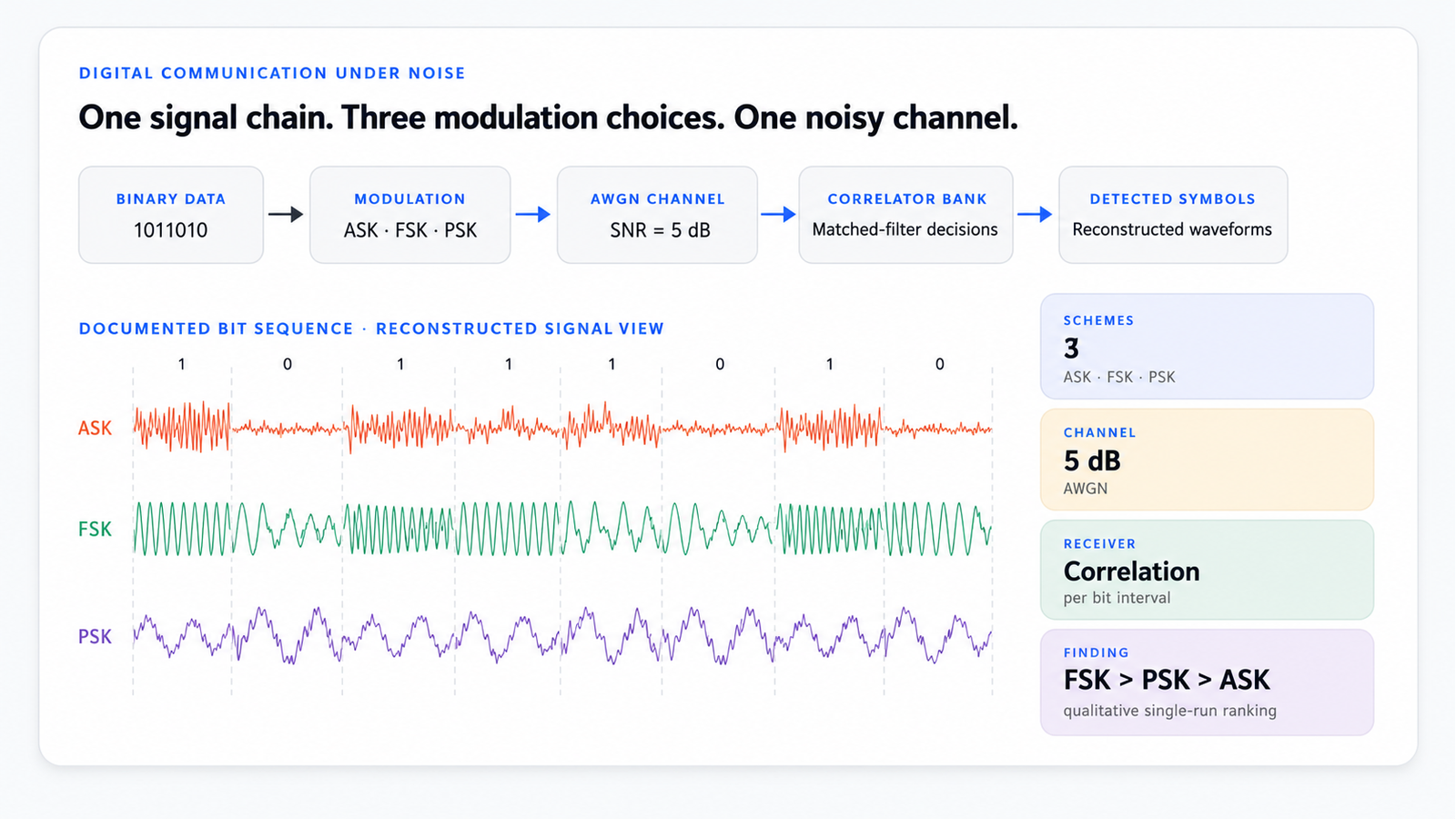
This project builds a complete simplified digital communication chain in MATLAB: generate a binary sequence, map it into ASK, FSK, and PSK waveforms, transmit each signal through a 5 dB AWGN channel, and apply coherent correlation decisions at the receiver. The documented run uses 1011010 and supports a bounded qualitative comparison—not a BER or repeated-trial performance claim.
02Context
Project Overview
Digital communication systems convert binary information into waveforms that can travel through an analog channel. ASK encodes symbols through amplitude, FSK through frequency, and PSK through phase. The modulation choice changes how noise affects the received signal and how the receiver should detect each symbol.
The study implemented all three schemes using the same seven-bit sequence and channel condition. MATLAB generated the clean waveforms, added AWGN, correlated each received bit interval with the appropriate reference signal, and reconstructed the detected modulation waveform.
The project is analytical and simulation-based. It does not include a physical transmitter, RF front end, real channel measurement, synchronization subsystem, or hardware receiver.
03Definition
Communication Problem & Objectives
How do three basic binary modulation schemes behave under the same noisy channel, and how can a reference-based receiver recover their transmitted symbols?
The comparison uses one documented seven-bit unipolar NRZ sequence, the same 5 dB AWGN condition for every scheme, and a coherent receiver that evaluates one complete bit interval at a time.
- 01Generate a seven-bit unipolar NRZ sequence.
- 02Implement ASK, binary FSK, and binary PSK using cosine references.
- 03Apply AWGN at SNR = 5 dB to every modulated waveform.
- 04Detect each symbol by correlation over one bit duration.
- 05Reconstruct the detected ASK, FSK, and PSK waveforms.
- 06Compare how amplitude, frequency, and phase encoding respond to the same noise condition.
- 07Identify the strongest and weakest qualitative behavior within the documented run.
- 08State clearly what the single-run simulation does not prove.
04Architecture
End-to-End Signal Chain
The modeled chain carries the same binary source through three modulation paths before independent noise is added and one receiver decision is made for every bit interval.
- 01Generate binary source
- 02Form unipolar NRZ
- 03Map ASK, FSK, or PSK
- 04Add 5 dB AWGN
- 05Correlate with references
- 06Apply hard decision
- 07Regenerate detected waveform
ASK and PSK use one coherent carrier reference. FSK compares two references because each symbol is represented by either 4 Hz or 8 Hz.
The report’s “after matched filtering” waveforms are ideal reconstructions after correlation-based decisions, not continuous raw matched-filter output traces.

05Configuration
Modulation Schemes & Parameters
The simulation uses intentionally simple educational parameters so the amplitude, frequency, and phase mappings remain directly traceable across the same seven bit intervals.
Number of bits
- Value
- 7
Documented sequence
- Value
- 1011010
Representation
- Value
- Unipolar NRZ
Bit duration Tb
- Value
- 2 s
Sampling frequency fs
- Value
- 110 Hz
Carrier frequency fc
- Value
- 1 Hz
FSK frequency for bit 0
- Value
- 4 Hz
FSK frequency for bit 1
- Value
- 8 Hz
Channel
- Value
- AWGN
SNR
- Value
- 5 dB
| Parameter | Value |
|---|---|
| Number of bits | 7 |
| Documented sequence | 1011010 |
| Representation | Unipolar NRZ |
| Bit duration Tb | 2 s |
| Sampling frequency fs | 110 Hz |
| Carrier frequency fc | 1 Hz |
| FSK frequency for bit 0 | 4 Hz |
| FSK frequency for bit 1 | 8 Hz |
| Channel | AWGN |
| SNR | 5 dB |
- ASK transmits the 1 Hz carrier for bit 1 and zero amplitude for bit 0.
- FSK transmits 8 Hz for bit 1 and 4 Hz for bit 0.
- PSK transmits 0° phase for bit 1 and a 180° phase reversal for bit 0.
- The source MATLAB script uses randi without a fixed seed. Public visuals use the documented sequence and do not imply that every execution produces it.
- The frequencies and long bit duration are educational simulation parameters, not a practical radio-frequency design.

06Reasoning
Key Engineering Decisions
Six choices keep the three modulation paths comparable while making the receiver operation explicit and the resulting evidence appropriately bounded.
01
Decision
Use identical source data and channel conditions
Compare ASK, FSK, and PSK using the same bit sequence and 5 dB SNR.
- Rationale
- A controlled comparison isolates the effect of the modulation dimension.
- Trade-off
- One short realization cannot establish general error-rate performance.
02
Decision
Use coherent cosine references
Generate and detect all schemes with known phase-aligned references.
- Rationale
- Correlation makes the symbol decision rule explicit and traceable.
- Trade-off
- The model assumes ideal synchronization and carrier knowledge.
03
Decision
Detect one complete bit interval at a time
Accumulate the correlation score over Tb.
- Rationale
- Integrating over the symbol interval suppresses zero-mean noise and emphasizes the matching reference.
- Trade-off
- Timing error and intersymbol interference are excluded.
04
Decision
Use a two-reference receiver for FSK
Compare the 4 Hz and 8 Hz correlation outputs.
- Rationale
- Binary FSK is a hypothesis-selection problem between two frequency templates.
- Trade-off
- Receiver complexity is higher than a single-reference detector.
05
Decision
Regenerate detected waveforms
Reconstruct an ideal ASK, FSK, or PSK waveform after each hard decision.
- Rationale
- The output clearly shows which symbol the receiver selected.
- Trade-off
- A clean reconstruction is not a raw filter output or measured channel waveform.
06
Decision
Keep conclusions qualitative
Rank the three schemes from the documented waveform behavior rather than claim quantitative superiority.
- Rationale
- The source contains one sequence, one SNR, and no BER study.
- Trade-off
- The ranking explains the documented run but cannot be generalized statistically.
07Model
Mathematical Model & Decision Rules
Each modulation rule defines one waveform per bit, while the coherent receiver condenses the noisy samples from that bit interval into one or two correlation statistics.
- ASK
sASK,k(t) = bₖ cos(2πfct)
Bit 1 transmits the carrier and bit 0 transmits zero amplitude.
- FSK
sFSK,k(t) = cos(2πf₁t) for bₖ = 1; cos(2πf₀t) for bₖ = 0
The two binary states use 8 Hz and 4 Hz references.
- PSK
sPSK,k(t) = cos[2πfct + π(1 − bₖ)]
Bit 1 uses 0° phase and bit 0 uses a 180° reversal.
- AWGN channel
r(t) = s(t) + n(t)
Independent white Gaussian noise is added at a modeled SNR of 5 dB.
- Correlation statistic
y = Σ r[n] φ[n]
Samples are multiplied by a known reference and summed over one bit interval.
- ASK decision
Choose 1 when yASK > Eφ / 2
The carrier correlation is compared with half the reference energy.
- FSK decision
Choose 1 when y₈Hz > y₄Hz
The receiver selects the reference with the larger correlation.
- PSK decision
Choose 1 when yPSK > 0
The correlation sign distinguishes the 0° and 180° states.
ASK
- Reference set
- cos(2πfct)
- Decision basis
- Half-energy threshold
FSK
- Reference set
- cos(2πf₀t), cos(2πf₁t)
- Decision basis
- Maximum correlation
PSK
- Reference set
- cos(2πfct)
- Decision basis
- Correlation sign
| Receiver | Reference set | Decision basis |
|---|---|---|
| ASK | cos(2πfct) | Half-energy threshold |
| FSK | cos(2πf₀t), cos(2πf₁t) | Maximum correlation |
| PSK | cos(2πfct) | Correlation sign |
The correlation receiver is mathematically equivalent to sampling a matched-filter output at the end of a symbol interval when the reference waveform is time-reversed appropriately.
The implementation expresses that operation directly as sample-by-sample multiplication and summation; the displayed detected waveforms are then regenerated from the hard decisions.
08Implementation
MATLAB Model Implementation
MATLAB defines the symbol, sampling, carrier, FSK, and SNR parameters before generating a binary vector and its unipolar NRZ waveform.
Explicit bit-by-bit loops construct the clean ASK, FSK, and PSK signals. AWGN is added from measured signal power, and each noisy bit interval is correlated with the appropriate reference waveform or pair of references.
After each hard decision, the model reconstructs the selected ASK, FSK, or PSK state. The direct implementation keeps the signal path traceable, although a larger model would normally preallocate arrays and separate modulation, channel, detection, and evaluation into reusable functions.
Evidence boundary
The MATLAB model demonstrates waveform generation and coherent symbol decisions under an idealized AWGN channel. It does not model synchronization error, fading, multipath, bandwidth limits, nonlinear amplification, pulse shaping, coding, or physical RF hardware.
09Evidence
Noise Impact at 5 dB
ASK shows the greatest amplitude ambiguity. Intervals intended to carry zero amplitude contain visible noise, and carrier-present intervals fluctuate around their ideal envelope.
FSK remains distinguishable because the information is carried by two separated frequencies. Noise changes the instantaneous waveform, but the 4 Hz and 8 Hz structures remain visually identifiable.
PSK retains its phase reversals, but noise reduces the sharpness of transition points and makes phase interpretation less visually direct.
The figure is a deterministic reconstruction from the documented parameters. Because the source code does not set a random seed, it is not presented as the exact original MATLAB noise realization.

10Outcome
Matched-Filter Detection & Comparative Findings
Correlation condenses each noisy bit interval into a decision statistic: ASK tests a carrier score against a half-energy threshold, FSK compares two frequency-reference scores, and PSK checks the sign of the carrier score.
For the documented seven-bit sequence at 5 dB SNR, the source report qualitatively ranks FSK first, PSK second, and ASK third. This is a single-run waveform comparison, not a BER result or statistical performance study.
FSK
- Observed behavior
- Frequency states remain most distinguishable
- Qualitative position
- 1
PSK
- Observed behavior
- Phase reversals remain identifiable but less clear
- Qualitative position
- 2
ASK
- Observed behavior
- Amplitude representation is most visibly disturbed
- Qualitative position
- 3
| Scheme | Observed behavior | Qualitative position |
|---|---|---|
| FSK | Frequency states remain most distinguishable | 1 |
| PSK | Phase reversals remain identifiable but less clear | 2 |
| ASK | Amplitude representation is most visibly disturbed | 3 |

The evidence does not support claims about universal robustness, BER, coding gain, output SNR improvement, statistical detection probability, or physical-channel performance.
11Reflection
Limitations & Engineering Takeaways
The study is most useful when its ideal receiver assumptions and single-run evidence boundary remain visible beside the engineering insights.
Model limitations
- One documented seven-bit sequence.
- One channel condition at 5 dB SNR.
- No repeated Monte Carlo trials.
- No BER-versus-SNR curve.
- No explicit recovered-bit table in the report.
- Ideal carrier phase and symbol timing.
- No pulse shaping or bandwidth constraint.
- No fading, multipath, interference, or frequency offset.
- No channel coding or synchronization subsystem.
- No hardware or measured waveform validation.
Engineering takeaways
- The modulation dimension determines how channel noise appears at the receiver.
- Correlation converts a noisy waveform segment into a compact decision statistic.
- FSK needs a bank of references, while ASK and PSK can use one coherent reference in this model.
- A clean regenerated waveform is evidence of a receiver decision, not proof that channel noise disappeared physically.
- Visual comparison is useful for understanding behavior but cannot replace BER analysis.
- Receiver assumptions are as important as transmitter modulation choices.
12Next steps
Future Direction & Resources
Future work would turn the bounded waveform study into a repeatable performance analysis and progressively introduce less ideal channel and receiver assumptions.
Future direction
- Record the detected bit vectors and calculate BER.
- Repeat the experiment across many random sequences.
- Sweep SNR and build BER-versus-SNR curves.
- Compare simulated BER with theoretical binary-modulation performance.
- Introduce timing and carrier-phase offsets.
- Add pulse shaping and bandwidth-limited channel models.
- Evaluate fading and multipath channels.
- Compare coherent and noncoherent FSK detection.
- Add channel coding and interleaving.
- Implement a real-time or software-defined-radio version.
Comparative findings
